

Jerry Saved My Soul
Or, better dead, than red.

I just interviewed Jay Blakesberg, the bon vivant rock and roll photographer whose work has graced galleries around the world. Memories are rarely as in high definition as one of Jay’s photos. I’m grateful for his work, for it allows me to time travel.
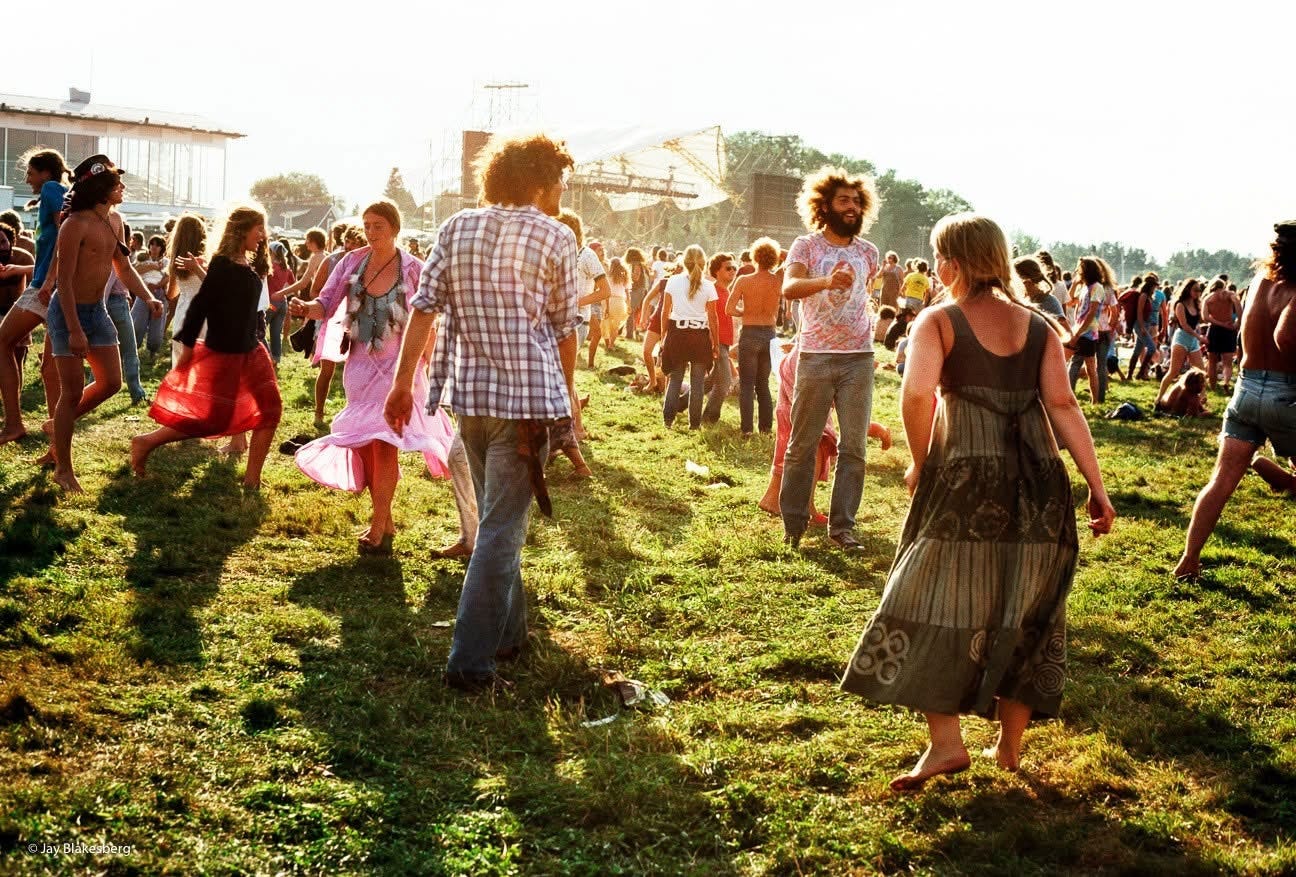
This is a Grateful Dead show in 1980 at the Lewiston Maine Fairgrounds.
It was not my first Dead show, but it was the first time I was outside and able to take my shoes off. I’ve written about this show before (see below), but what looking at this picture reminded of was two things:
How young we all were (I was 18).
How I was living with undiagnosed Extreme ADHD.
Something about the Grateful Dead experience, not often mentioned, is this - All neurotypes were welcome and encouraged.
This was expressed in a deeper sentiment by Dr. John Weir Perry, who spoke alongside Garcia and Joseph Campbell at a symposium called From Ritual to Rapture: From Dionysus to the Grateful Dead.
Dr. Perry believed that schizophrenia was closer to Campbell’s Heroes Journey, and that psychosis could, in the right atmosphere, lead to higher states of consciousness. In an eggshell, Perry believed that Grateful Dead shows could be environments where psychosis, neurosis or whatever ails your brain, could be “cured.”
That’s my takeaway and it’s probably a simplification - but I will hold my ground.
Disclaimer here; I promised my 15-year-old self not to ever become jaded about anything to do with the Grateful Dead, nor shit on anyone else’s experiences. So I cannot speak to what is, or isn’t happening, at Dead & Co shows.
What I do know is that in 1980, and hundreds of other Grateful Dead shows, if the gestalt of the show was perfect, it created a non-locational space.
Poet Hakim Bey’s "non-locational space" is a form of cultural experience, that exists outside everything we call social reality.
Which is to say, that at a lot, of Grateful Dead shows one could step into a zone where it felt like complete acceptance. And for somebody who was 18 and had zero handle on, nor could even put into words: ADHD, dyslexia, stuttering, chronic anxiety, task paralysis and more - acceptance was intoxicating.
I was a young teenage deadhead (and now a silver haired old deadhead) because the Grateful Dead experience, all together as one, made me feel heard. The constant was Jerry Garcia, the band, the music, the songs, the crowd and me.
But you couldn’t always find the door to the bigger room in the TARDIS of Dead shows. Sometimes it was just intensely personal and the world outside your face would do it’s own thing.
And sometimes, things became transcendent. If you have a hankering for more on this show, read on. Otherwise, thank you and have a decent day.
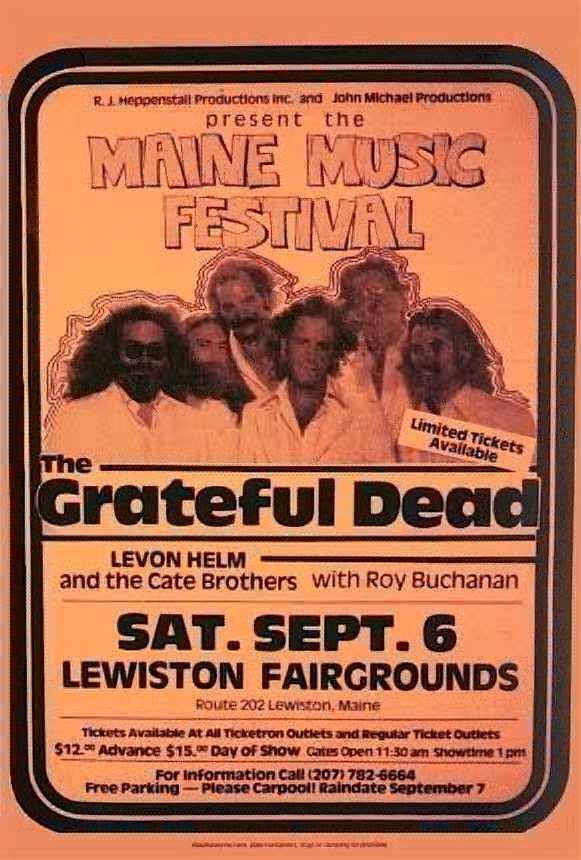
09-06-1980
I had like 20 or 30 Grateful Dead concerts under my belt. But this show in Lewiston, Maine was my first outdoor show. Personally, my life was in a bit of a downward spiral. I was 18-years-old. I had recently NOT graduated from High School because I failed gym, don’t ask. For good or ill, I still hadn’t found a steady girlfriend. Most of my buddies had left for college. I was reluctantly working at Swenson’s Ice Cream and dreading starting Kean University, in Union, NJ. I only applied because my father thought I was retarded (“Who fails gym!?!”).
It was a three show jaunt stopping in Springfield, Massachusetts and Providence, Rhode Island. Every show I had seen previously was indoors. Madison Square Garden, Nassau Coliseum, The Spectrum in Philly. I didn’t know what I was missing. Northeasterners are used to being inside. We spend upwards of 6 months a year inside, running between heat sources and finding ways to be creative indoors without going stir crazy. Sure, I had seen a couple of outdoor concerts. A mile from my house, in Jersey, they used to have bands like Beaver Brown, Gary US Bonds and the Starship play a makeshift bandstand in the archery field. But this was unlike anything I had experienced.
Entering Lewiston, Maine it seemed as if the entire town was welcoming, or looking to cash in on, the invading horde. People were standing in their driveways offering $10 parking to anyone desperate enough. Restaurants had “Welcome Deadhead” signs in their windows. The line of VW’s, broken down wrecks and school buses, en route to the show, was being viewed as a parade. Children were waving. There was no undercurrent of weirdness, it was a true community spectacle. Post-show articles cried and pooh-poohed the wild atmosphere that occurred when the circus came to town, but they cried to the bank.
The concert was to be held at the State Fairgrounds that was established in 1898. It was to be a trip back and forward in time, and by the time we parked and had eaten our vitamin A, it was close to the starting line.
I was used to people scampering to the stage and setting up perimeters. Establishing little Trumpian invisible walls between my space and their space. This was different. It was concentrated with heads up close at the stage, but mellow and inviting. This was a marked difference from any previous shows. Everyone made room for everyone else until Bob Weir shouted his signature Take a Step Back speech. And for the first time, and possibly only time, everyone did step back and make room so we weren’t crushing fellow fans. I took that as my cue and retreated about halfway back into the field where there was plenty of room to breathe.
Keyboardist Brent Mydland had only joined the band in April ’79. Gone were Keith and Donna. The Dead’s album Go To Heaven had come out a few months prior to the show and featured some real nice Brent tunes. Brent was my guy. I thought he had one of the best voices in the biz, his keyboard playing was colorful and he was obviously a long-haired freak. Over the years it became obvious that the reason he could sing the blues so well was because he was suffering. But at this show, he was fresh and unjaded and so was I.
The Dead played for three hours. The opening bands included the brilliant, legendary Levon Helm who made up another couple of hours. This was a full day into evening experience. By the time the Dead took the stage, me along with 25,000 others were primed and ready to rock.
I’m a loner at shows. I like being able to control where and when I want to wander. I didn’t want to have to make small talk or review what had just happened. This is not to say I was alone. I was surrounded by like-minded people who with just a few succinct words, I could bond with in solidarity and purpose. Unlike all the indoor shows I had seen, having the sky above with clouds in tow, really opened up the cosmic vista. An undeniable connection between fans, band and environment occurred. Gone was the cement underneath. I took my shoes off. This might seem, especially to my California friends, a simple enough move, but it was revelatory.
Unlike The Great Nothing in The Never Ending Story, there was a great something afoot and the music of the Grateful Dead was the conduit. And much like The Never Ending Story, every person there felt like they were the central character in a book that had never been read before. It was a grounding experience. My roles that I played at home, mostly that of a lowly ice cream scooper with a GED, melted away. I felt lucky as hell to be there and I knew I wanted more. Now, as many have argued before, it could have all been a dream brought on by hallucinogens and heightened experience and projected expectations. But it was a dream, nonetheless, and my thinking was a dream is better than no dream at all, or worse yet, suburbia.
I can paint limitless pictures of what seeing The Dead was like. But at the center, was Jerry Garcia. Think less rock and roll front man and more like a great jazzmen, like Coltrane or Miles. His voice through his guitar danced through the crowd with each participant feeling a close connection to it. He was a shaman guiding thousands of souls through the portal between here and there and infinity. It was serious biz. Yet throughout the entire day the spirit of the Yippies, Zippies and Pranksters prevailed. Nothing is too serious . . . unless it’s Deadly Sirius.
Side note: I had never danced at a show yet. I swayed and I rocked with my feet firmly planted in the ground. I held my ground. It was an internal battle between wanting to let loose and having grown up in a super rigid system. Despite the deafening battle between my ears, nobody, not one soul judged me, nor made me feel a stranger. Later on in this series I’ll delve into the cults that popped up around the scene, but in general, the rule of the moment was “kindness” and that was a lifestyle I deeply resonated with.
I still had a ways to go downhill, but what I realized that day was that if I could turn things around I could move to California and be in the land of outdoor shows.
It was a non-locational space, as Hakim Bey would say.